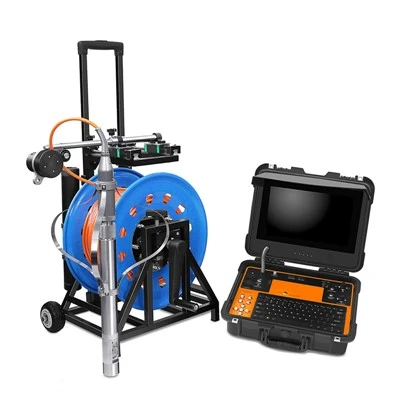
As a supplier of Pan Tilt Borehole Cameras, I've had countless discussions with clients about the accuracy of these nifty devices in detecting borehole defects. It's a topic that comes up time and time again, and for good reason. Boreholes are crucial in various industries, from water supply to geothermal energy, and any undetected defects can lead to significant problems down the line. So, let's dive into how accurate these cameras really are.
How Pan Tilt Borehole Cameras Work
Before we talk about accuracy, it's important to understand how these cameras operate. A Pan Tilt Borehole Camera is designed to be lowered into a borehole. The "pan" and "tilt" functions allow the camera to move horizontally and vertically, giving it a wide range of view. This is super handy because it can capture different angles and areas inside the borehole.
The camera is usually attached to a cable that also serves as a conduit for power and data transmission. As it descends, it sends real - time video footage to a monitor on the surface. This live feed enables operators to see what's going on deep inside the borehole, including any signs of defects.
Factors Affecting Accuracy
There are several factors that can impact how accurate a Pan Tilt Borehole Camera is in detecting borehole defects.


Camera Resolution
One of the most obvious factors is the camera's resolution. A high - resolution camera can capture more details, making it easier to spot small defects like cracks or corrosion. For example, if you're using a low - resolution camera, a hairline crack might just look like a smudge on the screen. On the other hand, a high - resolution camera will show the crack clearly, allowing for a more accurate assessment.
Lighting Conditions
Lighting is another crucial factor. Inside a borehole, there's no natural light, so the camera relies on built - in lights. If the lighting is too dim, parts of the borehole may be in shadow, and defects could be missed. On the flip side, if the lights are too bright, it can cause glare, which also makes it difficult to see clearly. Some of our Water Well Camera Inspection cameras are equipped with adjustable lighting systems to ensure optimal visibility.
Water Turbidity
In boreholes that contain water, turbidity can be a major issue. If the water is murky or full of sediment, it can obscure the camera's view. Even the best cameras struggle to see through extremely turbid water. In such cases, it might be necessary to take additional steps, like flushing the borehole to clear the water, before conducting an accurate inspection.
Movement and Stability
The stability of the camera is important for accurate defect detection. If the camera is shaking or moving erratically, it can be hard to get a clear view of the borehole walls. Our 45mm AHD 300m to 600m Remote Borehole Inspection Camera With Electrical Winch Function is designed with a stable mounting system and an electrical winch to control the descent and movement of the camera, reducing the chances of blurry or inaccurate footage.
Real - World Accuracy
In real - world applications, Pan Tilt Borehole Cameras are generally quite accurate at detecting major defects. For example, they can easily identify large cracks, collapses, or blockages in the borehole. These are the types of defects that are usually visible on the camera's live feed and can be quickly diagnosed.
However, when it comes to more subtle defects, like small voids or early signs of corrosion, the accuracy can vary. As mentioned earlier, factors like resolution, lighting, and water conditions play a big role. In some cases, additional testing methods may be required to confirm the presence of these subtle defects.
For instance, if a camera detects a suspicious area that might be a small crack, a non - destructive testing method like ultrasonic testing could be used to get a more accurate assessment. This combination of camera inspection and additional testing can improve the overall accuracy of defect detection.
Comparing with Other Methods
When compared to other borehole inspection methods, Pan Tilt Borehole Cameras have some distinct advantages in terms of accuracy.
Traditional Borehole Logging
Traditional borehole logging methods often rely on indirect measurements. For example, resistivity logging measures the electrical resistivity of the rock around the borehole to infer the presence of certain features. While these methods can provide valuable information, they don't offer a direct visual of the borehole. In contrast, a camera gives you a real - time, visual representation of what's inside the borehole, making it easier to accurately identify defects.
Sonar Imaging
Sonar imaging is another method used for borehole inspection. It works by sending sound waves into the borehole and measuring the echoes. While sonar can be useful for detecting large objects or changes in the borehole diameter, it doesn't provide the same level of detail as a camera. A camera can show the texture of the borehole walls, small cracks, and other fine details that sonar might miss.
Improving Accuracy
As a supplier, we're constantly looking for ways to improve the accuracy of our Pan Tilt Borehole Cameras.
Upgrading Camera Technology
We're always investing in the latest camera technology to improve resolution and image quality. For example, our 45mm Dual View Deep Water Well Camera Drilling Inspection Camera uses advanced image sensors and processing algorithms to enhance the clarity of the footage, even in challenging conditions.
Training Operators
Accuracy also depends on the skills of the operators using the cameras. We offer training programs to help operators understand how to use the cameras effectively, including adjusting the lighting, controlling the pan and tilt functions, and interpreting the footage. A well - trained operator is more likely to spot defects accurately.
Conclusion
In conclusion, Pan Tilt Borehole Cameras are a valuable tool for detecting borehole defects. They offer a direct visual inspection of the borehole, which is a significant advantage over many traditional inspection methods. While there are factors that can affect their accuracy, with the right technology, proper lighting, and skilled operators, these cameras can provide a high level of accuracy in detecting both major and some subtle defects.
If you're in the market for a reliable Pan Tilt Borehole Camera or want to learn more about how our cameras can improve your borehole inspection accuracy, don't hesitate to reach out. We're here to help you find the best solution for your specific needs and ensure that your borehole inspections are as accurate as possible.
References
- "Borehole Imaging Techniques for Geotechnical and Hydrogeological Investigations" - Journal of Geotechnical and Geoenvironmental Engineering
- "Advances in Borehole Inspection Technology" - Proceedings of the International Conference on Geotechnical Engineering