Hey there! As a supplier of Dual - View Borehole Cameras, I'm super excited to share with you the working principle of these amazing devices.
Understanding the Basics of a Dual - View Borehole Camera
First off, let's get a clear picture of what a Dual - View Borehole Camera is. It's a specialized piece of equipment designed to inspect the inside of boreholes. Boreholes are essentially holes drilled into the ground for various purposes, like water well construction, geotechnical investigations, or even mineral exploration.


A Dual - View Borehole Camera, as the name suggests, has two views. This is a game - changer compared to single - view cameras. It allows for a more comprehensive inspection of the borehole. One view might be looking straight ahead, while the other could be looking at the sidewalls of the borehole. This dual - view setup gives us a much better understanding of what's going on inside the borehole.
The Components of a Dual - View Borehole Camera
To understand how it works, we need to know its main components.
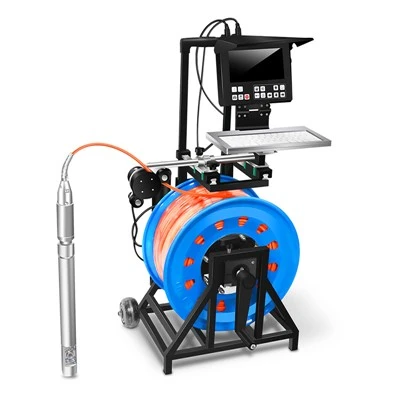
- Camera Heads: These are the eyes of the system. The camera heads are equipped with high - resolution lenses and sensors. The sensors capture the light that enters through the lenses and convert it into electrical signals. These signals are then processed to form an image. The two camera heads are strategically placed to provide different perspectives. One is usually facing forward to see what's ahead in the borehole, and the other is angled to view the sidewalls.
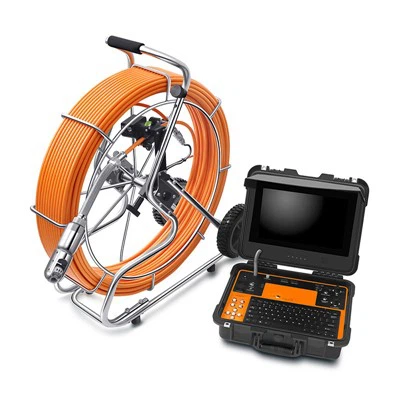
- Cable: The cable is like the umbilical cord of the camera. It not only provides power to the camera heads but also transmits the electrical signals (which represent the images) from the camera heads to the surface unit. The cable needs to be strong and flexible enough to be lowered into the borehole without getting damaged.
- Surface Unit: This is where all the magic happens on the surface. The surface unit receives the electrical signals from the camera heads via the cable. It then processes these signals to display the images on a monitor. The surface unit also has controls that allow the operator to adjust settings such as focus, brightness, and contrast.
How the Dual - View Borehole Camera Works
Let's break down the working process step by step.
- Lowering the Camera: First, the camera is carefully lowered into the borehole using the cable. The operator needs to be cautious to ensure that the camera doesn't get stuck or damaged during the descent. As the camera moves down the borehole, the two camera heads start capturing images.
- Image Capture: The camera heads use their lenses to focus on the objects inside the borehole. The light that reflects off these objects enters the lenses and hits the sensors. The sensors then convert the light into electrical signals. The forward - facing camera captures the view ahead, while the side - viewing camera captures the details of the borehole walls.
- Signal Transmission: The electrical signals representing the images are sent through the cable to the surface unit. The cable acts as a high - speed data highway, ensuring that the signals reach the surface unit quickly and accurately.
- Image Processing and Display: Once the signals reach the surface unit, they are processed by the internal electronics. The surface unit uses algorithms to convert the electrical signals into clear and sharp images. These images are then displayed on a monitor, allowing the operator to see what's happening inside the borehole in real - time.
Advantages of a Dual - View Borehole Camera
The dual - view feature offers several advantages.
- Comprehensive Inspection: With two views, we can get a much more complete picture of the borehole. For example, in water well construction, we can not only see the condition of the well casing but also check for any cracks or blockages in the surrounding rock formations.
- Time - Saving: Instead of having to use multiple single - view cameras or perform multiple inspections, a dual - view camera can provide all the necessary information in one go. This saves a lot of time and effort, especially in large - scale projects.
- Accurate Data Collection: The dual - view setup allows for more accurate data collection. This is crucial for making informed decisions, such as whether to repair a well or continue with an exploration project.
Our Products
We offer a range of high - quality Dual - View Borehole Cameras. You can also check out some related products on our website. For example, the Bore Hole Camera is a great option for general borehole inspections. If you need a camera for deeper water wells, the 100m Water Well Camera is a perfect choice. And for more advanced applications, the Underwater 45mm Camera 200m Borehole Video Inspection Camera with Electrical Winch provides excellent performance.
Conclusion
In conclusion, the working principle of a Dual - View Borehole Camera is based on a combination of advanced camera technology, signal transmission, and image processing. It's a powerful tool that can provide valuable insights into the condition of boreholes. If you're in need of a reliable Dual - View Borehole Camera for your project, don't hesitate to reach out for a discussion. We're here to help you find the best solution for your specific needs.
References
- Smith, J. (2020). Borehole Inspection Technologies. Journal of Geotechnical Engineering.
- Johnson, A. (2019). Advances in Downhole Camera Systems. International Journal of Mining and Exploration.