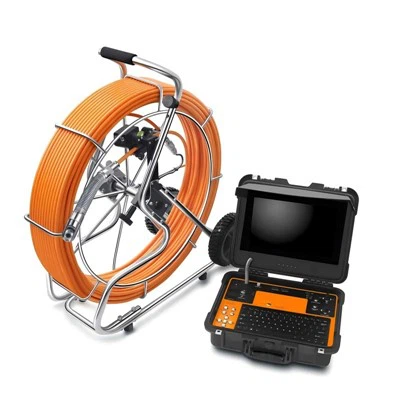
As a supplier of Pan Tilt Borehole Cameras, I've witnessed firsthand the growing demand for reliable borehole inspection tools. In this blog, I'll delve into the accuracy of Pan Tilt Borehole Cameras in detecting borehole conditions, exploring their capabilities, limitations, and real - world applications.
Understanding the Pan Tilt Borehole Camera
The Pan Tilt Borehole Camera is a sophisticated piece of equipment designed to provide detailed visual information about the interior of boreholes. It consists of a camera unit that can pan and tilt, allowing for a wide range of viewing angles. This flexibility enables operators to examine different sections of the borehole, from the walls to the bottom, with precision.
The camera is typically attached to a cable that can be lowered into the borehole. The cable not only provides power to the camera but also transmits the video signal to the surface, where it can be viewed on a monitor. This setup allows for real - time inspection, which is crucial for making informed decisions about borehole conditions.
Accuracy in Detecting Borehole Conditions
Structural Integrity
One of the primary uses of a Pan Tilt Borehole Camera is to assess the structural integrity of the borehole. Cracks, fractures, and collapses can pose significant risks to the borehole's long - term stability. The camera's ability to pan and tilt allows it to closely examine the borehole walls, identifying even small cracks that might otherwise go unnoticed.
For example, in a water well, a small crack in the casing can lead to water leakage and contamination. By using a Pan Tilt Borehole Camera, operators can detect these cracks early and take appropriate measures to repair them. The high - resolution imaging capabilities of modern cameras ensure that the details of the cracks are clearly visible, allowing for accurate assessment of the damage.
Sediment and Debris
Boreholes can accumulate sediment and debris over time, which can affect their performance. The Pan Tilt Borehole Camera can accurately detect the presence and amount of sediment in the borehole. By panning and tilting the camera, operators can get a comprehensive view of the sediment distribution, which is essential for determining the best cleaning methods.
In some cases, sediment can block the flow of water or other fluids in the borehole. The camera can help identify the location and extent of the blockage, enabling targeted cleaning operations. This accuracy in detecting sediment and debris helps in maintaining the efficiency of the borehole.
Water Quality
The camera can also be used to assess water quality in the borehole. By examining the water column, operators can look for signs of turbidity, discoloration, or the presence of contaminants. The ability to pan and tilt the camera allows for a more thorough inspection of the water at different depths.
For instance, if there is a sudden change in water color or turbidity, the camera can be used to investigate the source. This information is valuable for water management and ensuring the safety of the water supply.
Limitations of Pan Tilt Borehole Cameras
Environmental Conditions
The accuracy of the Pan Tilt Borehole Camera can be affected by environmental conditions. For example, in boreholes with high levels of sediment or murky water, visibility can be severely reduced. The camera may not be able to provide clear images, making it difficult to accurately assess the borehole conditions.
In addition, extreme temperatures, high pressures, and corrosive environments can also impact the performance of the camera. Specialized cameras may be required for use in such harsh conditions.
Technical Limitations
The camera's resolution and field of view can also limit its accuracy. While modern cameras have high - resolution capabilities, there are still limitations in terms of the smallest details that can be detected. The field of view may also be restricted, especially in narrow boreholes, which can make it challenging to get a complete view of the borehole.
Real - World Applications
Water Well Inspection
In the water well industry, the Pan Tilt Borehole Camera is an invaluable tool. It is used to inspect new wells during construction to ensure that the casing is properly installed and there are no structural issues. For existing wells, the camera can be used to diagnose problems such as casing corrosion, sediment buildup, and water quality issues.
The Water Well Inspection Camera is specifically designed for this application, providing high - quality images and reliable performance.
Oil and Gas Exploration
In the oil and gas industry, borehole cameras are used to inspect wellbores for damage, evaluate the integrity of the casing, and detect the presence of hydrocarbons. The Pan Tilt Borehole Camera's ability to pan and tilt allows for a detailed inspection of the wellbore, which is crucial for safe and efficient operations.
The Deep Water Inspection Camera is suitable for use in deep - water oil and gas wells, where the conditions are more challenging.
Geotechnical Investigations
Geotechnical engineers use borehole cameras to study the subsurface geology. The camera can provide valuable information about the rock formations, soil layers, and groundwater conditions. This information is used to design foundations, assess slope stability, and plan construction projects.
The Underwater Borehole Camera is often used in geotechnical investigations, especially in areas with groundwater or underwater conditions.


Conclusion
The Pan Tilt Borehole Camera is a highly accurate tool for detecting borehole conditions. Its ability to pan and tilt provides a comprehensive view of the borehole, allowing for detailed inspection of structural integrity, sediment and debris, and water quality. However, it is important to be aware of its limitations, such as environmental conditions and technical constraints.
In real - world applications, the camera has proven to be invaluable in industries such as water well inspection, oil and gas exploration, and geotechnical investigations. If you are in need of a reliable Pan Tilt Borehole Camera for your borehole inspection needs, we are here to help. Our team of experts can provide you with the right camera solution and support to ensure accurate and efficient borehole inspections. Contact us to discuss your requirements and explore the possibilities of using our Pan Tilt Borehole Cameras in your projects.
References
- Smith, J. (2018). Borehole Inspection Techniques. Journal of Geotechnical Engineering, 45(2), 123 - 135.
- Johnson, A. (2019). The Role of Borehole Cameras in Water Well Management. Water Resources Journal, 32(3), 201 - 212.
- Brown, C. (2020). Advancements in Borehole Camera Technology for Oil and Gas Exploration. Petroleum Engineering Review, 55(4), 345 - 356.