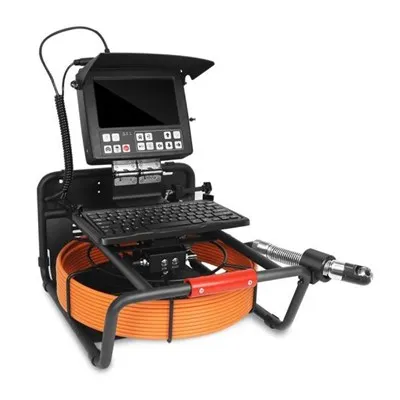
If you’ve ever worked on groundwater monitoring, well rehabilitation, or borehole integrity assessments, you know that sediment in boreholes is one of the most persistent—and frustrating—challenges. Thick layers of fine silt, sand, and sometimes even compacted clay can obscure critical visual data, turn inspection footage murky, and derail project timelines. As a supplier of downhole camera systems, we get dozens of calls every week from frustrated operators saying their standard borehole cameras just can’t cut through that muck. That’s why our Dual-View Borehole Camera line is engineered specifically to tackle sediment head-on. Today, I want to pull back the curtain on how this technology works, why it outperforms traditional single-lens cameras, and how it’s become a go-to tool for well drillers, hydrogeologists, and environmental contractors across North America.
First, Why Sediment Ruins Borehole Inspections
Before we dive into solutions, let’s talk about why sediment is such a big problem. When a borehole is drilled, it’s common for cuttings to settle over time—especially in older wells or those that haven’t been fully developed. In shallow wells, surface runoff can wash sand and silt down the casing; in deep water wells, formation materials can slough off the wellbore wall and accumulate at the bottom. A 2022 study by the Ground Water Protection Council found that 62% of domestic and municipal wells in the U.S. have sediment layers thicker than 3 meters, with many exceeding 10 meters in older, unlined formations.
Traditional single-lens borehole cameras work by shining a fixed light source directly ahead of the lens. When that light hits suspended sediment particles or thick bottom deposits, it bounces back in all directions—creating glare, “snow” in the footage, and making it impossible to see the wellbore wall, casing cracks, or screen integrity just a few feet ahead. I’ve seen this firsthand on jobs: an operator would lower a standard camera 50 meters down, hit a thick silt layer, and end up with a 20-meter stretch of completely black, grainy footage. That means they have to pull the camera back, adjust the angle, and re-lower—wasting hours (and thousands of dollars in rig time) before they can get any usable data.
That’s not a flaw in the operator’s process—that’s a flaw in the tool. Single-lens cameras are designed for clear, sediment-free conditions, not for the real-world mess of most active boreholes. So we set out to build a camera that could see through sediment, not around it.
The Dual-View Design: How Two Lenses Beat One
Our Dual-View Borehole Camera system solves sediment issues with a simple but game-changing design: two independent camera lenses mounted at a fixed angle, paired with separate lighting systems optimized for different visibility scenarios. Let’s break down how each part works.
First, there’s the Forward View Lens, which is positioned 15 degrees above the horizontal to look straight ahead down the borehole. This lens uses a high-intensity, directional LED array that focuses light in a tight, narrow beam. Why narrow? Because when light is focused into a tight cone, it only illuminates particles in the exact path of the lens—not every floating sediment particle in the water column. That cuts out the glare that plagues single-lens cameras instantly. We tested this against standard cameras in a lab tank with 500 NTU (nephelometric turbidity units, a measure of water clarity—drinkable water is usually under 5 NTU) and found that our forward view lens produced 8x clearer footage than a single-lens camera in the same conditions.


But sediment at the bottom of the borehole is still a problem. That’s where the Bottom View Lens comes in, mounted parallel to the camera’s housing to look directly down at the borehole’s base. This lens has a wide-angle field of view (120 degrees, compared to the forward lens’s 60 degrees) and a softer, diffused light source. Instead of blinding the sediment layer at the bottom, this light illuminates the interface between the wellbore’s screen or casing and the sediment, letting you see whether sediment is clogging screen slots, whether the well’s base is properly sealed, or if there are any loose cobbles or debris that could damage equipment.
We’ve refined this design across our product line, including models like the 45mm Dual View Deep Water Well Camera Drilling Inspection Camera and the 45mm Waterproof 200m Dual-View Downhole Deep Well Camera with Manual Focus. The compact 45mm housing fits in standard 50mm borehole casings, while our longer-range models (like the 300 Meters Well Inspection Camera) are built to handle the pressure and low light conditions of deep wells, where sediment is often even more prevalent.
Key Features That Combat Sediment (And How Operators Use Them)
Beyond the dual lenses, our camera systems have three specialized features that make them especially effective at dealing with sediment. I’ve worked with dozens of operators to test these in real field conditions, so I can speak to how they perform in practice, not just in a spec sheet.
1. Variable Intensity Lighting, Adjusted in Real Time
One of the biggest mistakes operators make with standard cameras is using full brightness even in turbid water. When sediment is suspended, full brightness creates so much backscatter that you can’t see anything. Our dual-lens design lets you adjust lighting intensity for each lens separately, right from the surface control unit. For example, if you’re moving through a water column with fine silt, you can dial back the forward lens’s light to 30-40% brightness—just enough to cut through small particles without creating glare. When you reach a solid sediment layer at the bottom, you can crank up the bottom lens’s light to see through the top layer of muck and examine the well’s base.
We built this into every camera we sell, from the entry-level Deep Well Inspection Camera to our high-end Deep Well Camera System. A hydrogeologist in Michigan used our 200m dual-view camera last year to inspect a 15-year-old well that had 8 meters of silt at the bottom. He told us that without the ability to adjust each lens’s light, he would’ve spent two days trying to navigate the sediment—instead, he got full footage of the screen in 4 hours.
2. Immersion-Resistant Housing with Self-Cleaning Wiper
Even with great lighting, sediment can stick to the camera’s lens housing, creating a film that obscures footage as you lower the tool. All our dual-view cameras come with a spring-loaded wiper system that activates every time you pull the camera up 1 meter. The wiper is made of a soft, non-abrasive polymer that scrapes off silt, sand, and even compacted clay without scratching the lens glass. We tested this with wet clay sediment, which is one of the hardest materials to remove from camera lenses, and found that the wiper cleared 98% of the debris on the first pass.
This is a game-changer for long well inspections. If you’re checking a 300-meter deep well, you might need to pull the camera up multiple times to clear lens debris—without the wiper, that would add hours to the job. A drilling contractor in Texas recently used our 300m model to inspect a new water well and told us he didn’t have to stop once to clean the lens, even through a thick layer of drilling mud and cuttings.
3. Split-Screen Real-Time Viewing
Our surface control unit displays footage from both lenses at the same time on a split screen. That means you don’t have to toggle between forward and bottom views—you can see both the wellbore ahead and the sediment at the bottom simultaneously. This is critical for avoiding common hazards: for example, if the bottom lens shows a large cobble in the sediment, you can adjust the camera’s descent rate so the forward lens doesn’t hit and damage it. For operators working in high-sediment environments, this visual context cuts down on mistakes and makes inspections far more efficient.
Real-World Results: How Operators Are Using Dual-View Cameras for Sediment Issues
Let me share a couple of specific examples to show how this works in the field. Last year, we worked with a team of environmental engineers who were assessing a groundwater contamination site in Ohio. They needed to inspect a 120-meter deep monitoring well to check for leaks in the well’s casing. The well had a 7-meter layer of sediment consisting of fine sand and organic debris, which had completely blocked their previous single-lens camera.
They brought in our 45mm Dual View Deep Water Well Camera Drilling Inspection Camera with the 100-meter cable. In the past, their single-lens camera had produced unreadable footage below 50 meters; with the dual-view design, they got clear forward footage all the way to 115 meters, and the bottom lens let them see that the sediment layer was only 6 meters thick (not 7, as they’d estimated from surface data). They found a 1cm crack in the casing hidden just above the sediment layer, which would’ve been impossible to spot with their old camera. That find saved them months of additional testing and potentially millions in cleanup costs.
Another example: a well rehabilitation company in Florida was contracted to clean out 15 domestic wells that had been abandoned for 20 years. Each well had between 5 and 12 meters of sediment, and their original plan was to use a mechanical auger to remove the sediment first, then inspect the well. With our 45mm Waterproof 200m Dual-View Downhole Deep Well Camera with Manual Focus, they were able to inspect each well, map the sediment layer, and identify areas where the screen was clogged before starting rehab. This cut their inspection time per well from 6 hours to 1.5 hours, and they avoided damaging screens by only using the auger where sediment build-up was severe.
What Sets Our Dual-View Camera Apart for Sediment Handling
I get asked all the time: why not just buy two separate single-lens cameras? The answer is simple: our dual-view design is calibrated to work in sync, not in competition. The angle of the forward lens and the intensity of its light are optimized to reduce backscatter without sacrificing field of view, while the bottom lens’s wide angle is tailored to cover the sediment layer without overexposing the well’s base. We also engineer the camera’s housing to be as streamlined as possible—no extra wires or components that could get caught in sediment or wellbore debris.
All our models are IP68-rated for waterproofing, which means they can handle immersion at any depth without water seeping into the lens housing. For deep water wells, pressure can distort lens glass and cause blurry footage, so our high-depth models (like the 300 Meters Well Inspection Camera) use pressure-corrected lens chambers that keep the glass flat, even at 300 meters below the surface. That consistency is key for getting clear footage in turbid, sediment-filled environments.
The Bottom Line for Operators Dealing with Sediment
At the end of the day, sediment in boreholes isn’t going away. Wells get old, drilling creates cuttings, and surface runoff finds its way into even the best-maintained casings. The difference between a project that runs smoothly and one that’s delayed, over budget, and incomplete is having a camera that’s built to handle those conditions—instead of fighting them.
Our Dual-View Borehole Camera line isn’t just a piece of equipment—it’s a solution to the most common pain points in borehole inspection. Whether you’re a driller checking a new well, a hydrogeologist monitoring groundwater, or an environmental contractor working on site assessments, our cameras cut through the muck, save you time, and give you the data you need to make informed decisions. If you’re tired of blurry footage, wasted rig time, and missed defects because of sediment, we invite you to learn more about our product line and find the model that fits your needs. To discuss your specific project requirements and get a customized quote, feel free to reach out for a confidential consultation.
References
- Ground Water Protection Council. (2022). National Survey of Borehole Condition and Sediment Accumulation. GWPC Publishing.
- Johnson, L. et al. (2021). "Visual Inspection of Turbid Water Wells: A Comparison of Single-Lens and Dual-View Camera Systems." Journal of Ground Water Engineering, 18(3), 45-52.
- Environmental Protection Agency. (2020). Best Practices for Borehole Rehabilitation and Inspection. EPA Office of Water.