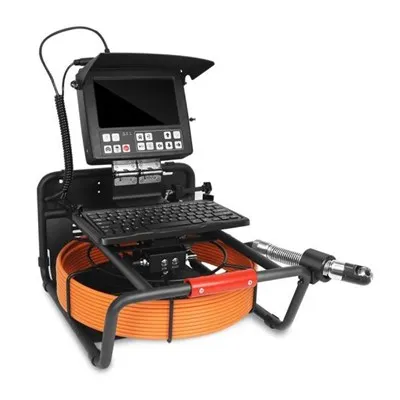
If you’ve ever worked in geotechnical engineering, groundwater monitoring, or oil and gas exploration, you know how critical it is to see what’s happening deep below the surface. Dual-view borehole cameras have become indispensable tools here, letting you capture both a forward-looking view and a panoramic side view of boreholes, wells, and drilling sites. But one question comes up in almost every technical conversation I have as a borehole camera supplier: What is the maximum operating temperature of a dual-view borehole camera?
This isn’t a trivial question. Boreholes can go thousands of feet deep, and temperatures rise steadily with depth—geothermal gradient typically adds about 1°F for every 70 feet, meaning a hole that’s 10,000 feet down can hit 150°F, and in some regions, it’s even hotter. If your camera can’t handle that heat, you’ll get blurry footage, frozen sensors, or worse, a broken tool stuck down the hole. Over my years in this industry, I’ve seen teams waste time and money on cameras that fail because their temperature specs were too low, so let’s break this down clearly.
First, let’s define what “maximum operating temperature” actually means for borehole cameras, especially dual-view models. It’s not just the air temperature at the surface where you’re operating the camera. It’s the temperature of the downhole environment—rock formations, groundwater, and drilling fluid—where the camera’s core components are sitting. These components include the image sensor, processing chip, motor (for pan-tilt functions if you have them), and wiring insulation. Each of these has its own heat limits, so the whole camera’s max temp is the lowest limit of all parts working together.
When we design our dual-view cameras, we start with understanding real-world downhole conditions. For most standard applications—water well inspection, shallow geotechnical boreholes, or small-scale drilling—operational temps range from 32°F (0°C) to 140°F (60°C). But what if you’re working in a deeper well, geothermal site, or an oil and gas well that hits 175°F (79°C) or more? You need a camera built for high-heat environments.
Our high-performance dual-view models, like the 45mm Dual View Deep Water Well Camera Drilling Inspection Camera, are rated for a maximum operating temperature of 185°F (85°C). Wait, you might say, that’s not super hot—but let’s explain why. That 185°F rating is tested under real borehole conditions, not just in a lab oven. We don’t just leave a camera in an oven at 185°F for 10 minutes and call it good. We cycle it through temperature changes, simulate vibration from drilling, and run video continuously to make sure the sensor and processing chip don’t overheat and die. If a camera is rated at 200°F but can’t handle vibration or continuous power, that rating is useless in practice.
I’ve seen this play out with a customer last year who bought a cheap, unrated dual-view camera for a 1,500-foot well in West Texas. The well’s temperature hit 165°F, and the camera died after just 20 minutes of use. They called me panicking because the camera was stuck 1,500 feet down, and they had to bring in a specialized recovery team that cost them three times what the camera was worth. That’s why it’s not just about the number on a spec sheet—it’s about how that number is tested for downhole use.


Now, let’s talk about what happens when a dual-view camera exceeds its maximum operating temperature. The first sign is usually distorted footage—colors fade, images get grainy, or the pan-tilt motor stops working. If the heat keeps rising, the sensor can “burn out” permanently, which means you’ll lose your view entirely. And as that West Texas customer learned, if your camera’s internal components expand too much from heat, wiring can fray, and parts can seize up, leaving you with a stuck tool that’s expensive to retrieve.
You might be wondering: Can you extend a camera’s operating temperature with cooling? For shallow applications, maybe—some teams use cooler fluid pumped around the camera, but for deep, high-heat boreholes, that’s not practical. Adding cooling parts adds bulk to the camera, which makes it harder to lower down narrow holes, and those parts themselves have heat limits. It’s better to get a camera designed to handle the heat from the start.
Not all dual-view borehole cameras are the same. Our Borehole Video Camera line, for example, has a standard max temp of 140°F (60°C) for general use, but for demanding applications, the 50mm AHD 360° View Pan Tilt Water Well Borehole Camera Inspection 100m-200m can go up to 165°F (74°C). For even deeper wells or geothermal projects, our Pan Tilt Borehole Camera models are engineered with high-temperature materials—like ceramic circuit boards, heat-resistant sensors, and high-temperature wiring—to hit that 185°F (85°C) max.
Let’s also clarify a common misconception: The “maximum operating temperature” is different from the “storage temperature.” A camera might survive being left in a hot truck for a weekend (that’s storage), but it’s a totally different thing to run it continuously in that heat while it’s working. We test our operating temperature ratings by running the camera 24/7 at the rated temp to make sure it holds up over hours of use, which is what you need for full borehole inspections.
When choosing a dual-view borehole camera, here’s what I recommend: First, know your borehole’s actual depth and expected temperature. You can get this from well logs, geological surveys, or by testing the temperature with a simpler temperature probe before buying a camera. If your well is under 1,000 feet and under 140°F, a standard model will work. If it’s between 1,000 and 2,000 feet and up to 165°F, go for the mid-heat model. For anything deeper than 2,000 feet or geothermal sites, you’ll want the high-heat 185°F-rated model.
I also always tell customers to check the camera’s IP rating, too—since boreholes are wet, water can get in and cause shorts, especially when combined with heat. Our Downhole Well Camera line has IP68 ratings, meaning they’re fully waterproof and dustproof, which pairs with high temp performance to keep the camera working even in harsh conditions.
Over the years, I’ve had customers come back to me with horror stories about cameras that failed mid-inspection. Once, a team doing a well integrity test in Oklahoma had a camera die halfway through checking for cracks in the well casing. They had to pull the whole camera up, take it apart, and find it had overheated from the well’s 170°F temp. The whole project was delayed by two days, costing them thousands in lost time. That’s why getting the right camera with a confirmed maximum operating temperature isn’t just a technical detail—it’s a business decision.
So, to answer the original question clearly: The maximum operating temperature of a dual-view borehole camera depends on the model and its design. Standard models for shallow, low-heat boreholes typically max out at 140°F (60°C), mid-range models for moderate depths go up to 165°F (74°C), and high-performance models for deep, high-heat applications can handle up to 185°F (85°C). Always verify the rating is for continuous downhole operation, not just lab testing, and match it to your borehole’s actual temperature to avoid costly mistakes.
At the end of the day, a dual-view borehole camera is only as good as its ability to work in the conditions you put it in. If you’re working in a hot borehole, don’t cut corners on temperature specs. If you need help picking the right dual-view camera for your project—whether it’s a shallow water well, deep drilling inspection, or geothermal site—we’re here to help. Reach out to discuss your specific needs, and we can guide you to the camera that will perform reliably, even in the toughest downhole temperatures.
References
- International Society of Soil Mechanics and Geotechnical Engineering. (2019). Borehole Imaging Technologies for Subsurface Investigation. Elsevier.
- API Recommended Practice 58. (2020). Reliability of Instrumentation for the Petroleum and Natural Gas Industries. American Petroleum Institute.
- World Health Organization. (2018). Groundwater Temperature and Its Impact on Well Construction and Monitoring. WHO Press.
- Downhole Camera Industry Standards. (2021). International Association of Drilling Contractors.
- Thermal Management for Downhole Electronic Systems. (2017). Journal of Petroleum Technology, Vol. 69, No. 5, pp. 45-52.