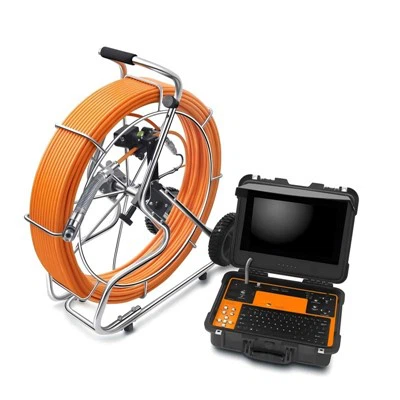
Yo! As a supplier of Dual - View Borehole Cameras, I'm super excited to share with you how these nifty gadgets ensure accurate orientation of the images. It's like having a little detective down in the borehole, giving you a clear view from all angles.
First off, let's understand what a Dual - View Borehole Camera is. It's a specialized camera designed to be lowered into boreholes, which can be deep underground or underwater. These cameras have two viewing angles, usually a forward - looking and a side - looking view. This dual - view feature allows for a more comprehensive inspection of the borehole walls and the area around the camera.
So, how does it ensure accurate image orientation? Well, one of the key components is the built - in orientation sensors. These sensors are like the camera's internal compass and gyroscope. They can detect the camera's position in three - dimensional space, including its tilt, roll, and yaw. By constantly monitoring these parameters, the camera can adjust the image it captures to ensure that it's presented in the correct orientation.
Let's say the camera is tilted to one side while it's down in the borehole. The orientation sensors will detect this tilt and send a signal to the camera's processing unit. The processing unit then corrects the image so that it appears level and upright on the monitor at the surface. This is crucial for accurate analysis of the borehole conditions. For example, if you're looking for cracks or irregularities in the borehole walls, having the image in the correct orientation makes it much easier to spot these issues.
Another factor that helps with accurate orientation is the camera's mounting system. A good Dual - View Borehole Camera is designed to be stable and secure when it's lowered into the borehole. The mounting system ensures that the camera doesn't move or rotate unexpectedly, which could throw off the image orientation. Some cameras come with a pan - tilt mechanism, like the Pan Tilt Borehole Camera. This allows the operator to control the camera's movement and adjust the viewing angle as needed. With a pan - tilt mechanism, you can precisely aim the camera at different areas of the borehole, ensuring that you get clear and accurately oriented images.
The lighting system on the camera also plays a role in image orientation. Adequate lighting is essential for getting clear images in the dark environment of a borehole. The lights are usually positioned around the camera lens to provide even illumination. This not only helps in seeing the details clearly but also gives a reference point for the camera's orientation. For example, if the lighting is symmetric around the image, it's easier to determine if the image is level and properly oriented.
Now, let's talk about the software that accompanies the camera. Modern Dual - View Borehole Cameras come with advanced software that can further enhance image orientation. The software can process the data from the orientation sensors and make real - time adjustments to the image. It can also provide additional features like image stitching, which allows you to combine multiple images taken from different angles to create a panoramic view of the borehole. This panoramic view can give you a better understanding of the overall structure and condition of the borehole, and because the images are accurately oriented, the stitching process works smoothly.
The data transmission system is another important aspect. The camera needs to send the captured images and orientation data to the surface in real - time. A reliable data transmission system ensures that the information arrives without any loss or distortion. This is crucial because any errors in the data could lead to incorrect image orientation. For example, if the orientation data is corrupted during transmission, the software on the surface might not be able to correct the image properly.
Let's take a look at some of our products that are designed with these features in mind. The Underwater 45mm Camera 200m Borehole Video Inspection Camera with Electrical Winch is a great example. It's specifically designed for underwater borehole inspections. The camera has high - quality orientation sensors and a stable mounting system, which ensures accurate image orientation even in challenging underwater conditions. The electrical winch allows for easy lowering and raising of the camera, and it also helps in keeping the camera in a stable position during the inspection.
The Down Hole Camera is another popular option. It's suitable for deep - borehole inspections and has a powerful lighting system. The lighting system provides excellent illumination, which not only helps in getting clear images but also aids in image orientation. The camera's software is also designed to handle the orientation data effectively, ensuring that the images are presented in the correct way.
The Borewell Camera 500 Feet is perfect for borewell inspections. It has a long cable that allows it to reach deeper into the borewell. The camera is equipped with advanced orientation sensors and a pan - tilt mechanism, which gives you full control over the viewing angle. This means you can get accurate and detailed images of the borewell walls from different perspectives.


Our Deep Water Inspection Camera is designed for inspections in deep - water environments. It's built to withstand high pressure and has a robust design. The camera's orientation sensors are calibrated to work accurately in deep - water conditions, and the software can adjust the image orientation based on the specific challenges of the deep - water environment.
If you're in the market for a reliable Dual - View Borehole Camera, we've got just what you need. Our cameras are designed to provide accurate image orientation, clear and detailed images, and reliable performance. Whether you're working on a borehole for geological surveys, water well inspections, or any other application, our cameras can help you get the job done right.
So, if you're interested in our products and want to discuss your specific requirements, don't hesitate to reach out. We're here to help you find the perfect camera for your needs and ensure that you get the most accurate and useful data from your borehole inspections.
References
- "Borehole Imaging Technology: Principles and Applications" by XYZ Author
- "Advances in Downhole Camera Systems" by ABC Research Group