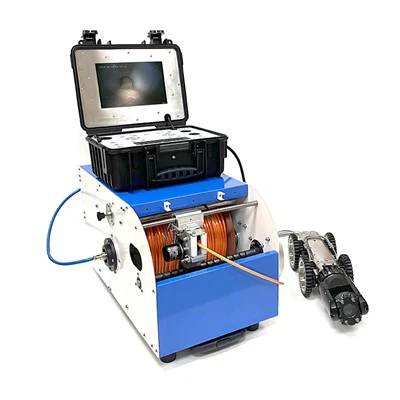
As a well - established supplier of Pipe Crawlers, I understand the challenges and significance of transferring the data collected by these remarkable devices. Pipe Crawlers are essential tools for inspecting the interior of pipes, sewers, and other conduits. They are equipped with various sensors and cameras to capture detailed information about the pipe's condition, such as cracks, blockages, and corrosion. Once this valuable data is collected, the next crucial step is to transfer it effectively for further analysis and decision - making.
Understanding the Data Collection Process of Pipe Crawlers
Pipe Crawlers are designed to navigate through pipes of different sizes and configurations. Our Pipe Crawler models come with high - resolution Crawler Inspection Camera systems that can capture sharp images and videos. These cameras are often mounted on flexible booms or articulated arms to provide a comprehensive view of the pipe's interior. In addition to visual data, Pipe Crawlers may also collect other types of information, such as acoustic data to detect leaks and elevation data to map the pipe's topography.
The data is stored in an on - board memory unit of the Pipe Crawler itself. The capacity of this memory can vary depending on the model and the requirements of the inspection task. For large - scale projects, it is essential to have sufficient storage to ensure that all the data is captured without interruption.
Wired Data Transfer Methods
One of the most common and reliable ways to transfer data from a Pipe Crawler is through a wired connection. A long, durable cable is used to connect the Pipe Crawler to a control unit at the surface. This cable not only provides power to the Crawler but also serves as a data transfer medium.
Ethernet Connectivity
Many of our advanced Pipe Crawler models support Ethernet - based data transfer. Ethernet offers high - speed data transmission rates, which is crucial when dealing with large volumes of video and sensor data. With an Ethernet connection, the data can be transferred at speeds of up to 1 Gigabit per second or even higher in some cases. This enables real - time monitoring of the inspection process at the control station. Engineers and technicians can view the live feed from the Crawler Inspection Camera and make immediate decisions based on the visual information.
Serial Communication
Serial communication is another wired method that can be used for data transfer. It is a simple and reliable way to transmit data in a sequential manner. Although the data transfer rate of serial communication is generally lower than Ethernet, it is still suitable for applications where the amount of data is relatively small or where the inspection environment does not require high - speed data transfer. For example, when transferring basic sensor readings, such as temperature or pressure data from the Pipe Crawler, serial communication can be a cost - effective solution.
Wireless Data Transfer Methods
Wireless data transfer offers greater flexibility compared to wired methods. It eliminates the need for long cables, which can be cumbersome and limit the range of the Pipe Crawler.
Wi - Fi Technology
Our Pipe Crawlers can be equipped with Wi - Fi modules to enable wireless data transfer. Wi - Fi provides relatively high - speed data transmission within a limited range. In a controlled inspection environment, such as a sewer system in a building or a small - scale industrial complex, a Wi - Fi connection can be established between the Pipe Crawler and a nearby access point. The data can then be transmitted to a central server or a mobile device for on - site analysis. However, the range of Wi - Fi is limited, and signal interference can be a problem in some environments.
Cellular Communication
For larger - scale projects, cellular communication can be a viable option. Our Pipe Crawlers can be integrated with cellular modems to transfer data over the mobile network. This allows the data to be sent to a remote server located anywhere in the world. Cellular communication provides a wide coverage area, which is especially useful for inspecting pipelines in rural or remote areas. However, it also depends on the availability of cellular network signals. In some areas with poor network coverage, the data transfer may be slow or unreliable.
Bluetooth Technology
Bluetooth is a short - range wireless communication technology that can be used for data transfer in some cases. It is mainly suitable for transferring small amounts of data, such as configuration settings or diagnostic information, between the Pipe Crawler and a nearby device, such as a smartphone or a tablet. Bluetooth is easy to set up and does not require a complex infrastructure, making it a convenient option for quick and simple data transfer tasks.


Data Storage and Backup
Once the data is transferred from the Pipe Crawler, it needs to be stored securely for future reference. We recommend using a combination of local and cloud - based storage solutions.
Local Storage
Local storage devices, such as external hard drives or solid - state drives (SSDs), can be used to store the data locally. This provides quick access to the data for on - site analysis. Local storage also offers an additional layer of security in case of any issues with the cloud - based storage.
Cloud - Based Storage
Cloud - based storage solutions offer several advantages, including scalability, accessibility, and data redundancy. Our customers can store their Pipe Crawler data on trusted cloud platforms, which can be accessed from any device with an internet connection. Cloud storage also provides automatic backup and data replication, ensuring that the valuable inspection data is not lost.
Data Analysis and Reporting
The ultimate goal of collecting and transferring data from a Pipe Crawler is to gain insights into the condition of the pipes and make informed decisions. Our company provides software solutions that can analyze the collected data and generate detailed reports.
Image and Video Analysis
The software can analyze the images and videos captured by the Crawler Inspection Camera to detect defects, such as cracks, leaks, and blockages. Advanced algorithms can be used to measure the size and location of these defects, providing accurate information for maintenance and repair planning.
Sensor Data Analysis
In addition to visual data, the software can also analyze the sensor data collected by the Pipe Crawler. For example, it can analyze acoustic data to detect leaks and elevation data to map the pipe's topography. This comprehensive analysis provides a complete picture of the pipe's condition.
Based on the analysis results, the software can generate detailed reports that include visual evidence, defect descriptions, and recommended actions. These reports are essential for communicating the inspection results to stakeholders, such as engineers, facility managers, and regulatory authorities.
Choosing the Right Data Transfer Method
The choice of data transfer method depends on several factors, including the nature of the inspection project, the amount of data to be transferred, the distance between the Pipe Crawler and the control station, and the availability of infrastructure. For small - scale projects in a limited area with a low volume of data, wired methods or Bluetooth may be sufficient. For larger - scale projects in remote areas or where real - time monitoring is required, wireless methods such as cellular communication may be more appropriate.
If you are interested in purchasing our Pipe Crawler, CCTV Stormwater, CCTV Tractor Camera, or Robotic Crawler Pipe Inspection System, we welcome you to contact us for a detailed discussion. Our team of experts will be happy to answer your questions and provide you with technical support and customized solutions to meet your specific needs.
References
- Pipe Inspection Technology Handbook.
- Wireless Communication Standards and Best Practices.
- Data Storage and Management in Industrial Applications.